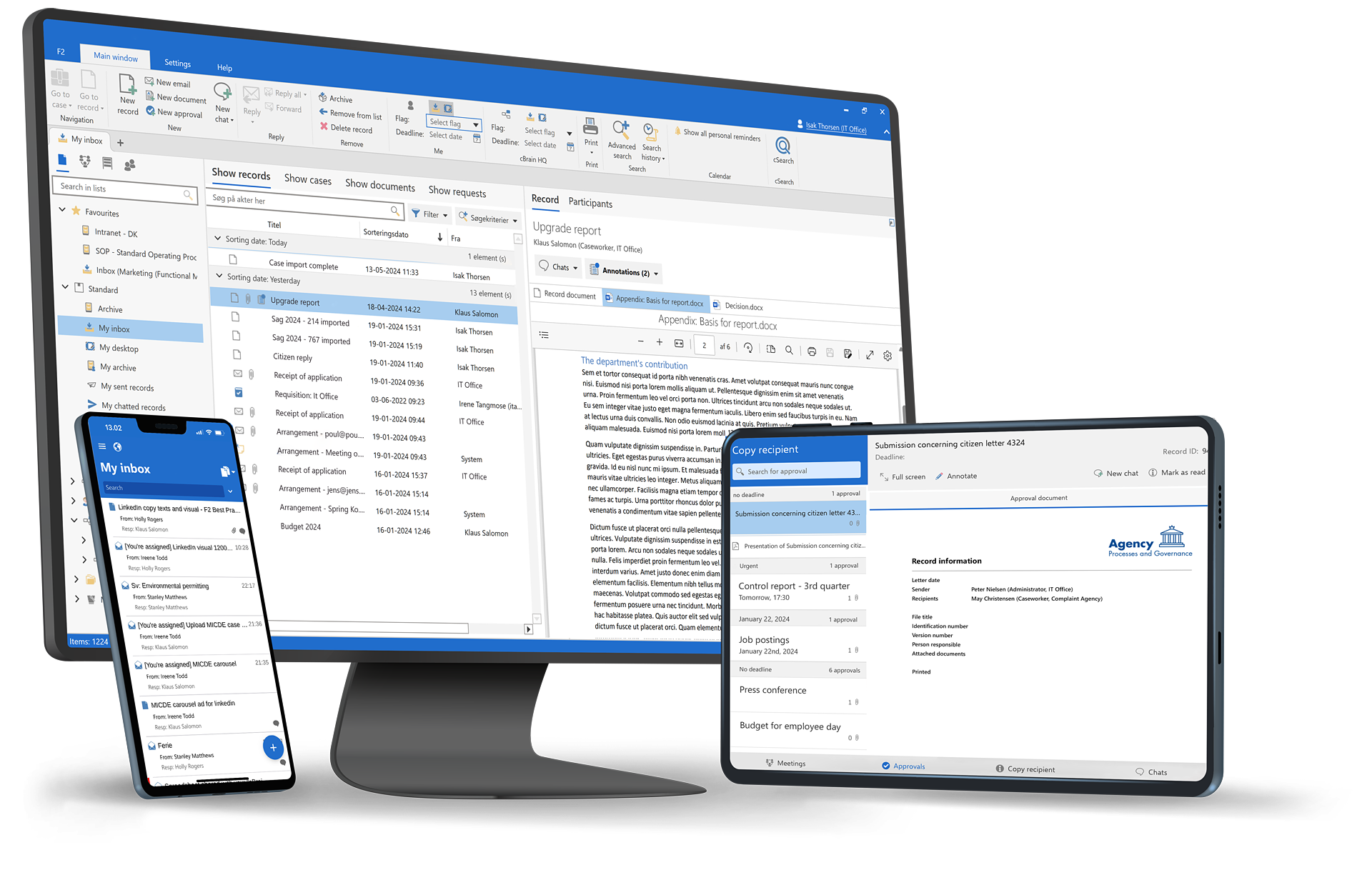

Maintain shared registers as authoritative sources across processes.

Registers provide centralized, governed master data that can be reused consistently across cases, documents, workflows, and communication.

Authoritative data. Maintain shared master data centrally.

Consistent use. Reuse data across processes.

Better Governance. Control updates and quality.

Product overview

Centralized master data registers

  • Shared registers for core entities
  • Reuse across cases and processes
  • Consistent identifiers and attributes
  • Controlled updates and governance
  • Reduced duplication and errors
Book a demo

Key benefits

Single source
Register data is defined once and reused everywhere.
Better consistency
Shared data stays uniform across processes and products.
Reduced errors
Central control prevents duplicates and conflicting information.

Core capabilities

Register definition
  • Define register structures and fields
  • Support different register types
  • Apply organization-wide standards
Data governance
  • Control who can create or update entries
  • Maintain data quality
  • Support compliant data handling
Reuse at scale
  • Reference register data across cases
  • Use registers in workflows and forms
  • Avoid repeated data entry

How it works

Approvals are surfaced to decision-makers through F2 Manager and F2 Touch, allowing secure review and action while maintaining full auditability.

Book a demo

How it works

A few simple steps are all that are needed to ensure a consistent and compliant process:

  1. Administrators define request types with workflows and rules
  2. Users submit requests using structured forms
  3. Requests are routed automatically to the right roles — also externally
  4. Decisions and approvals are documented
  5. Requests are completed with full audit trail

All steps are managed within the shared data model of cBrain F2, ensuring consistency across processes and products.

Book a demo

How it works

A few simple steps are all that are needed to ensure a consistent and compliant process:

  1. FOI requests are received via email, portals, or internal registration
  2. Requests are automatically structured as FOI cases
  3. Documents are collected, reviewed, and approved within the workflow
  4. Decisions and disclosures are formally documented
  5. Responses are sent with full traceability and audit logging

All steps are handled within the shared data model of cBrain F2, ensuring consistency and reuse across the organization.

Book a demo

Use cases

Reference data

Reuse authoritative data across cases and documents.

Process consistency

Ensure workflows rely on the same data definitions.

Data governance

Support long-term information management.

Trusted by government leaders

“Registers give us a reliable foundation for consistent data across processes.”
Head of Information Management
“We avoid duplication by reusing the same data everywhere.”
Enterprise Architect
“Central registers significantly improve data quality.”
Data Governance Lead

Security & compliance

Controlled updates

Only authorized users can modify register data.

Data integrity

Changes are consistent, traceable, and auditable.

Secure access

Register access follows role-based permissions.

Frequently asked questions

Are registers shared across processes?
Arrow Down Icon
Can registers be customized?
Arrow Down Icon
Are changes auditable?
Arrow Down Icon

Ready to see how we can help you?

Please provide us with some information about yourself, and we will connect you with the most suitable expert. We offer a range of options, from a discussion on your digitalization challenges to a complimentary consultation reviewing your current processes.
Thank you, we have received your request and will be in touch shortly.
Oh no! Something went wrong while submitting the form. Please try again.

How it works

Administrators define and govern registers centrally, and users reference register data wherever consistent master data is required.

Book a demo